
🌿 Yashio Danchi and Keihin Canal Ryokudō Park: A Waterfront Neighbourhood of Brick, Trees, and Open Sky
In the far southeastern corner of Shinagawa, Yashio Apartment Complex (Yashio Danchi) blends modern residential design with an unbroken ribbon of greenery along the water. This part of the city was once reclaimed tidal flats. Today, it is home to large apartment blocks such as Shioji Heights and the leafy Keihin Canal Ryokudō (京浜運河緑道公園) – the Keihin Canal Greenway. Together, they show how 1980s Tokyo embraced the idea of a “garden city”; urban living softened by trees, open sky, and waterfront walks.
🏢 The Neighbourhood
Built in the early 1980s, the apartment complexes here follow the clean, functional style of Japan’s public housing of the period. Pale brick facades, generous courtyards, and practical layouts cater to families and older residents alike. The wide pedestrian paths and landscaped spaces reflect a time when city planners prioritised greenery as much as housing capacity. A full profile of Yashio Apartment Complex can be found in Spot 92.
🌳 What is a Ryokudō Park?
Ryokudō (緑道) means “greenway” – a type of linear park, usually built along old railways, canal banks, or utility corridors. Designed mainly for walking and cycling, these spaces also act as safe evacuation routes, connectors between parks and schools, and havens for urban wildlife. Most are managed by local or metropolitan governments under the Urban Park Law.
The design often combines tree-lined footpaths, benches, small play areas, and seasonal planting. In waterfront areas like Yashio, ryokudō parks also give residents a direct connection to the water, improving both views and quality of life.
🚶 Keihin Canal Greenway Park
Opened in 1975 and stretching for about 2.5 kilometres along the east bank of the Keihin Canal, this park is part of the Tokyo Metropolitan Government’s network of Kaijō Kōen (seaside parks). It runs from near Wakashio Bridge to Katsushima Bridge, passing right through the Yashio district. Managed by the Amenis Kaijō Nanbu Area Group on behalf of the Port of Tokyo, it offers a peaceful promenade for joggers, walkers, anglers, and anyone who enjoys watching the changing light on the water.
Shaded by mature trees and with long views across the canal, the route has a gentle pace. In spring, cherry blossoms brighten the paths; in autumn, the leaves turn gold and red. Benches, water features, and low planting make it an easy place to linger, while the nearby monorail adds a quiet hum of city life in the background.
🧭 Visitor Information
Address: Along Keihin Canal, around Yashio 1 and Yashio 5, Shinagawa-ku, Tokyo 140-0003
Opening date: 1 December 1975
Length: Approximately 2.5 km
Best season: Spring for cherry blossoms, autumn for foliage
Facilities: Footpaths, benches, trees, fishing spots, jogging route
Admission: Free
Official Info: Tokyo Metropolitan Bureau of Ports and Harbors Marine Park List
📍 Where is it?
| what3words | ///worked.became.dodging |
| latitude longitude | 35.600245, 139.747263 |
| Nearest station(s) | Oi Keibajo-mae Station (Tokyo Monorail) |
| Nearest public conveniences | On Yashio – East of the Yashio, Kamome and Katsushima bridges. |
🪧 Show me a sign
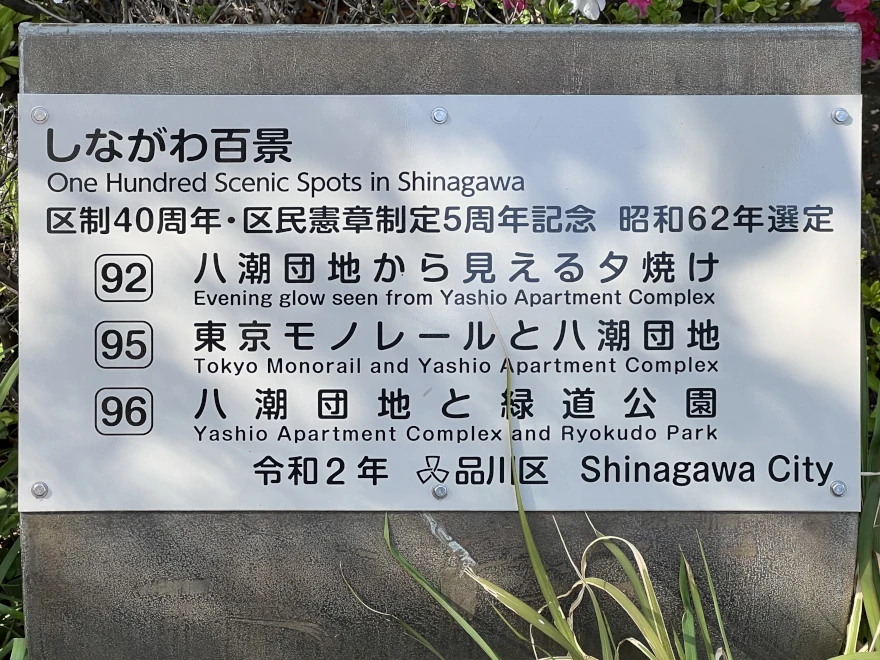
A triple sign for spots relating the Yashio Danchi. It’s at the west end of the Kamome Bridge.
🖋️ Withervee Says…
The park itself runs around the apartment complex. It’s a pleasant walk and nice and shady in midsummer beneath the greenery.
Another Sign
On the side of the greenway footpath next to the Keihin canal is a sign. On it is a map and a plaque.
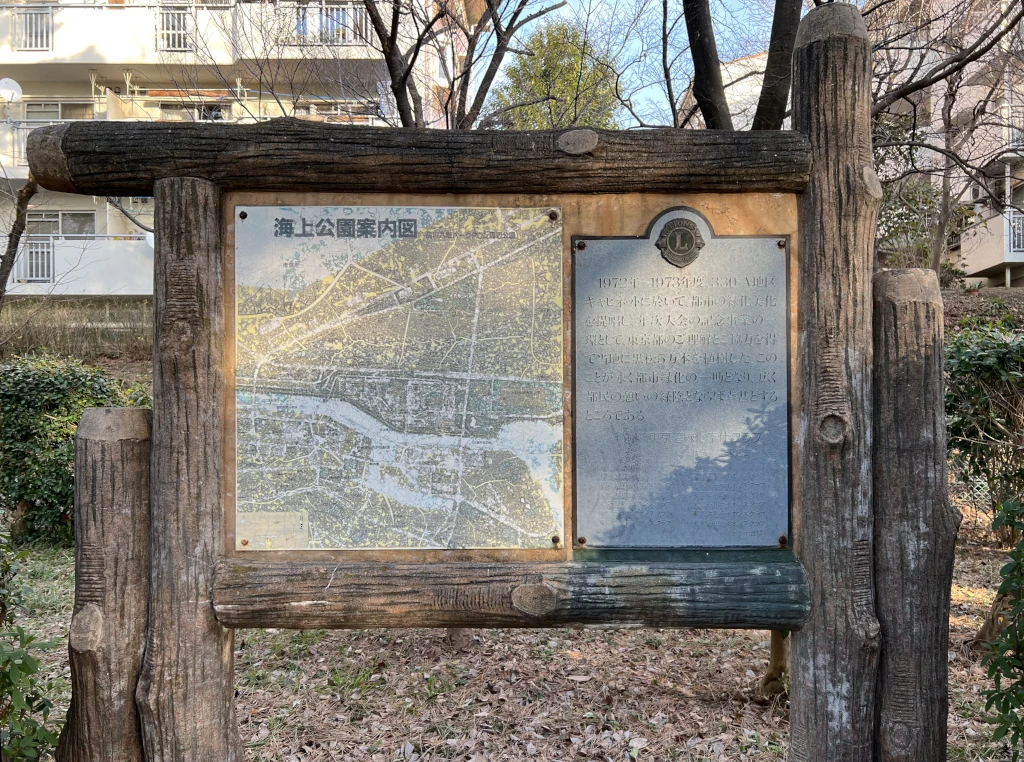
The barely legible map of the area has a faint red “You are here mark”. Up is east on this map – the direction you’re facing when you look at the map. The map may have been drawn before the area was developed. It’s hard to tell. It seems to show the Monorail and the Shinkansen depot.
The plaque headed Lions International reads:
1972年・1973年度 330-A地区
キャビネットに於いて、都市の緑化美化を提唱し、年次大会の記念事業の一環として、東京都のご理解とご協力を得て当地に黒松5万本を植樹した。このことが永く都市緑化の一助となり、広く都民の憩いの緑陰とならば幸甚とするところである。
東京湾緑化奉仕クラブ
代表 三木直雄
(五十音別)
東京浅草ライオンズクラブ
東京大森ライオンズクラブ
東京蒲田ライオンズクラブ
東京江東ライオンズクラブ
東京芝浦ライオンズクラブ
東京白鷗ライオンズクラブ
東京荏原ライオンズクラブ
東京大井ライオンズクラブ
東京蔵前ライオンズクラブ
東京品川ライオンズクラブ
東京浜町ライオンズクラブ
東京羽田ライオンズクラブ
Which in English reads:
In the years 1972 and 1973 Lions District 330-A’s cabinet promoted urban greening and beautification. As part of a commemorative project for the annual convention, and with the understanding and cooperation of the Tokyo Metropolitan Government, 50,000 Japanese black pines were planted here. We hope this will contribute to urban greening for many years, and that it will become a shaded place of rest for the people of Tokyo.
Tokyo Bay Greening Service Club
Representative: Miki Naoto
(In (Japanese) alphabetical order)
Tokyo Asakusa Lions Club
Tokyo Ōmori Lions Club
Tokyo Kamata Lions Club
Tokyo Kōtō Lions Club
Tokyo Shibaura Lions Club
Tokyo Hakuo Lions Club
Tokyo Ebara Lions Club
Tokyo Ōi Lions Club
Tokyo Kuramae Lions Club
Tokyo Shinagawa Lions Club
Tokyo Hamachō Lions Club
Tokyo Haneda Lions Club
That explains how all the trees got here. Many Lions Club International Tokyo members planted 50,000 trees.
Lions Clubs International is a worldwide volunteer service organisation made up of local Lions clubs. Clubs raise money, donate time, and run community projects that respond to local needs, often in partnership with public bodies such as schools, hospitals, or municipal agencies. Many activities are organised at “district” level, where a district leadership team coordinates projects across multiple clubs in one region.
🌳 Site Character
- Lifestyle 生活 (Seikatsu): ✔️
- Historical Significance 歴史 (Rekishi): ❌
- Atmosphere/Natural Features 風土 (Fūdo): ✔️
👥 Who in their right mind would vote for this?
- Urban design nerds
- Suburb enthusiasts
- Architecture lovers
- Families and stroller-pushers
- Hidden Tokyo wanderers
📚 Further reading
Ministry of Land, Infrastructure, Transport and Tourism – Park and Green Space Project
Lions Clubs International – District 330a (Tokyo)
Lions International – Official site
🚶 While you’re there…
Stroll through the Yashio waterfront area along the Ryokudō and catch views of the monorail slicing through the skyline near Yashio Bridge. Or admire views from the Kamome and Yashio bridges.