
🚝 Tokyo Monorail – Glide to Haneda Over Tokyo’s Waterfront
High above the Keihin Canal, the sleek silver trains of the Tokyo Monorail glide past warehouses, bridges, and apartment towers — a moving ribbon of steel connecting central Tokyo to Haneda Airport. For Yashio residents, it is a familiar sight; for travellers, it is one of the fastest and most scenic ways to reach the capital from the skies.
📜 From the Olympics to Today
The Tokyo Monorail began service on 17 September 1964, just weeks before the opening of the Tokyo Olympics. It was built to give athletes, officials, and visitors a fast, congestion-free link between Haneda Airport and the city centre. Designed using the Alweg straddle-beam system – a German innovation manufactured under licence by Hitachi – the line was one of the first of its kind in Japan.
Originally running from Hamamatsuchō to the old Haneda terminal, the line has grown in stages: extensions in 1993 to new domestic terminals, 2004 to Terminal 2, and 2010 to the international terminal (now Terminal 3). Station names were updated in 2020 to match Haneda’s terminal numbering.
🚈 Monorail Route and Scenery
The 17.8 km route begins at Hamamatsuchō, connecting with JR’s Yamanote and Keihin-Tōhoku lines. From there, the monorail sweeps through Tennōzu Isle, past the Yashio waterfront, and over the Keihin Canal. At the mouth of the Ebitori River, the track dips into an under-river section before reaching the airport’s three terminals.
From the elevated sections, passengers enjoy views of Tokyo Bay, port cranes, container ships, and in clear weather, distant mountain ranges. Passing Yashio Park Town and the graceful Kamome Bridge, the train offers a unique perspective on Shinagawa’s mix of residential and industrial landscapes. For many travellers, the Yashio Danchi is one of the first or last sights they see when travelling between Tokyo and Haneda. That is, if they are not mesmerised by the TCK racecourse on the opposite side.
🔧 Design and Comfort
The Tokyo Monorail uses an elevated straddle-beam design, allowing it to cross over roads and waterways with minimal land acquisition. Much of the alignment follows canals, reducing both construction cost and impact on existing neighbourhoods.
Modern trains feature wide doors, luggage racks, barrier-free interiors, and multilingual signage. Services range from all-stops locals to non-stop Haneda Express runs, with peak-time departures as frequent as every three minutes. End-to-end travel takes just 13 – 18 minutes, depending on the service.
🌉 Connection to Yashio
Although there is no station in Yashio itself, the monorail is part of the area’s daily life. Residents see and hear it passing along the waterfront, often framed by the green spaces of Yashio Park Town. The nearest monorail stations – Tennōzu Isle to the north and Ōikeibajōmae to the south – are accessible via local buses and walking paths.
📅 Final Thoughts
For visitors, the Tokyo Monorail is more than an airport link — it is a moving observation deck over Tokyo’s working waterfront. For locals, it is a dependable spine of the transport network. Whether you are arriving for the first time or returning home, gliding into Haneda over the Keihin Canal remains one of Tokyo’s most distinctive travel experiences.
Yashio Park Town
The Yashio Park Town complex was completed between 1983 and 1984 and includes large-scale apartment buildings such as Shioji Minami Dai-1 Heights, Shioji Kita Heights, and Village House Yashio Tower. These buildings range from 2LDK to 4LDK layouts, with community features like walking paths, gardens, and generous green buffers between roads and residences.
The area’s design emphasizes human-scale urbanism, with the elevated monorail gliding past like a sentinel of connectivity. Residents benefit from views of the water, fast access to Haneda, and a peaceful, planted setting. The juxtaposition of sleek rail technology and thoughtful residential design makes this one of the quieter but more harmonious areas of Shinagawa’s bayside.
Greater detail on Yashio Danchi is covered in 92 Evening glow seen from Yashio Apartment Complex
🧭 Visitor Information
Location: Near 3-10 Yashio, Shinagawa-ku, Tokyo
Best time to visit: Morning or dusk, especially for photographers
Admission: Free
Official Info: Tokyo Monorail
Where is it?
| what3words | ///worked.became.dodging |
| latitude longitude | 35.600245, 139.747263 |
| Nearest station(s) | Oi Keibajo-mae Station (Tokyo Monorail) |
| Nearest public conveniences | East of Kamome Bridge, across the road after the crossing. Or Lawson, or within the Patria shopping mall. |
Show me a sign.
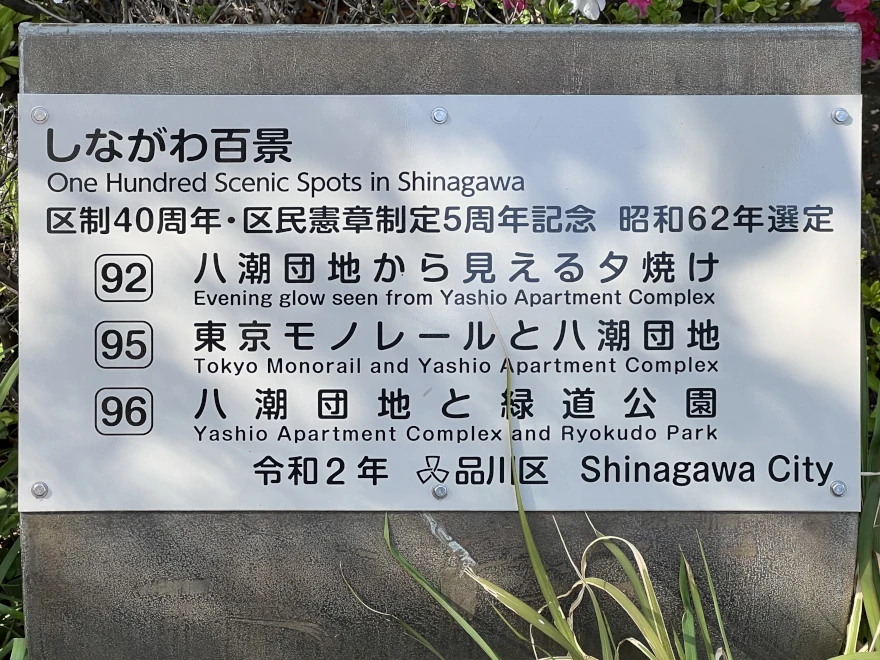
A triple sign for spots relating the Yashio Danchi. It’s at the west end of the Kamome Bridge.
Withervee says…
Presumably chosen for the urban-scenic contrast, this spot exemplifies the city’s complex infrastructure woven into the everyday lives of its residents. It’s got strong diagonal lines, repeating shapes, movement, and stillness — all in one. Great for slow city photography. Or trainspotting!
Site Character
- Lifestyle 生活 (Seikatsu): ✔️
- Historical Significance 歴史 (Rekishi): ❌
- Atmosphere/Natural Features 風土 (Fūdo): ✔️
Who in their right mind would vote for this?
- Urban rail lovers
- Photographers with an eye for perspective
- Architecture enthusiasts
- Locals with an appreciation for transit scenery
Further reading
Tokyo Monorail Haneda Airport Line
While you’re there…
Follow the water route south toward Nagisa no Mori.