
Shinagawa Aquarium: Learning from Tokyo’s Water, One Tank at a Time
🌊 An aquarium shaped by rivers, bay, and daily life
Shinagawa Aquarium (しながわ水族館) is designed around a simple idea: water connects the city. Rather than starting with distant oceans, the exhibits trace a path from rivers flowing into Tokyo Bay through tidal flats and coastal shallows, and out toward the open sea. This structure gives the visit a clear narrative, even if you move through it at an unhurried pace.
Opened in 1991, the aquarium was built as a local cultural facility rather than a destination landmark. That intention still shows. The focus remains on everyday environments, familiar species, and the ways people and marine life share space in and around Tokyo.
Because the galleries are compact and clearly laid out, you rarely feel rushed. Instead, the space encourages short stops, careful looking, and repeat visits, especially for families living nearby.
🐟 Tokyo Bay as a living system, not a backdrop
Several core exhibits focus directly on Tokyo Bay and the rivers that feed it. Tanks showing mudflats, rocky shorelines, and coastal fish highlight environments that many visitors know only from train windows or maps. Here, those places gain texture, movement, and scale.
Interpretive panels and staff-led talks help explain how these ecosystems function, from small invertebrates to larger fish. The aim is not spectacle but recognition. You are meant to connect what you see in the tanks with the geography just beyond the aquarium walls.
This local emphasis also makes the aquarium useful as a learning space. Children, in particular, can link school lessons about rivers or bays to something tangible and alive.
🦈 Immersion through movement and scale
The aquarium’s most recognisable feature is its 22-metre tunnel tank. Curving gently overhead, the tunnel places visitors directly beneath rays, sharks, and schooling fish. The experience works not because it is overwhelming, but because it is long enough to slow your walking pace.
At scheduled times, the tunnel becomes the stage for a short underwater show, with divers moving through the tank above visitors’ heads. These presentations last only a few minutes, yet they add a sense of scale and interaction without interrupting the flow of the galleries.
Elsewhere, themed tanks such as “coexistence” displays and rotating topical exhibits provide contrast, ensuring that the visit alternates between broad views and close observation.
🐬 Shows, talks, and small encounters
Live programmes play an important role at Shinagawa Aquarium. Dolphin, sea lion, and seal shows are held daily in an intimate setting, making them especially popular with younger visitors. Because seating is limited, planning around show times can shape your visit.
In addition to performances, the aquarium runs daily “Ikimono Talk” sessions led by keepers. These short talks introduce specific species, such as penguins or selected fish, and often rotate content depending on the day. The tone is practical and approachable rather than theatrical.
Paid experiences, including behind-the-scenes tours and feeding sessions, offer a closer look at daily care and maintenance. These options reinforce the aquarium’s role as a working facility rather than a static display.
🌳 A place that blends into the park
Set within Shinagawa Kumin Park, the aquarium naturally combines with a walk, picnic, or playground visit. Many families treat the aquarium as one part of a longer day outdoors rather than a stand-alone destination.
This setting softens the transition back to the city. After the darker interior spaces, the open lawns and paths feel like a continuation of the experience, rather than an abrupt end.
For that reason, Shinagawa Aquarium works particularly well on weekends or during seasonal events, when the park itself becomes part of the attraction.
🧭 Visitor Information
Address: 3-2-1 Katsushima, Shinagawa-ku, Tokyo 140-0012
Opening hours: Typically 10:00–17:00 (last entry around 16:30; check daily calendar)
Closed: Tuesdays and January 1 (with exceptions during school holidays)
Admission: Adults ¥1,350 / Primary & junior high ¥600 / Age 4+ ¥300 / Seniors (65+) ¥1,200
Local discount: Reduced admission is available for Shinagawa residents, workers, and students with proof.
Official site: Shinagawa Aquarium
📍 Where is it?
| what3words | ///pixies.securing.residual |
| latitude longitude | 35.58932, 139.73717 |
| Nearest station(s) | Ōmorikaigan Station (Keikyu Line) |
| Nearest public conveniences | Inside Shinagawa Aquarium / Kumin Park restrooms |
🪧 Show me a sign
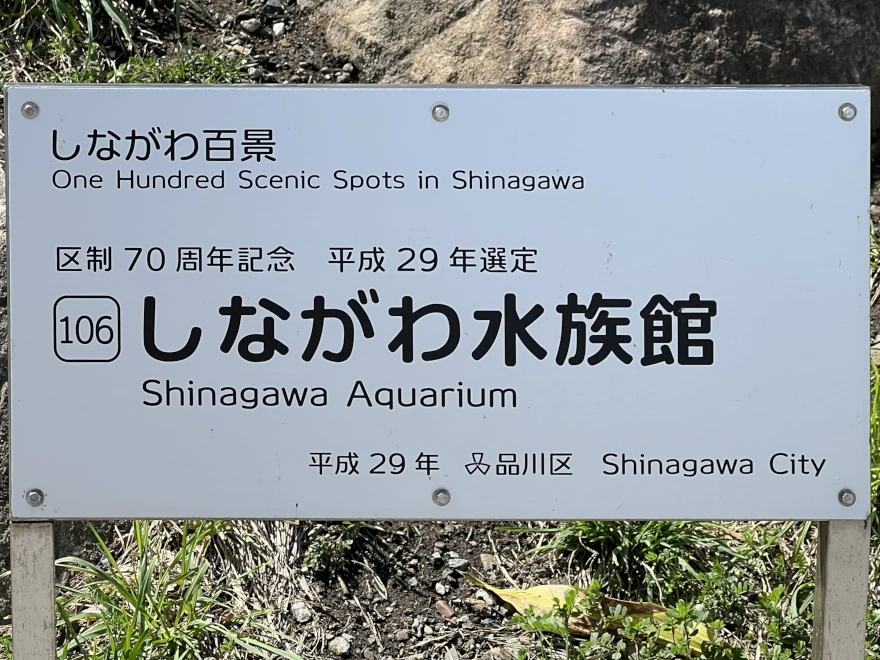
The sign is near the aquarium entrance
🖋️ Withervee Says…
Tokyo’s larger aquariums tend to work by accumulation. They are louder, darker, taller, and engineered to impress in stages. You move through them as if through a sequence of set pieces, each designed to top the last. Shinagawa Aquarium takes the opposite approach. It scales everything down and lets attention do the work.
✨ Spectacle versus proximity
Where the big aquariums aim for spectacle, Shinagawa stays domestic. Tanks sit closer to eye level. Pathways are shorter. You notice behaviour rather than choreography. The tunnel tank does not overwhelm; it simply slows you down long enough to feel present beneath it.
⏱️ Endurance versus ease
This difference matters. In larger facilities, the visit often becomes an endurance exercise, shaped by queues, timing, and a sense of forward motion. Here, there is no pressure to “get your money’s worth.” You can loop back, pause, or leave early without feeling you have missed something essential.
🏡 Destination versus local place
Shinagawa Aquarium is not a destination aquarium. It is a local one. It fits into an afternoon rather than consuming it. That modesty is its defining strength. If you want to be impressed, Tokyo offers many options. If you want to look carefully, this is the better place.
🌳 Site Character
- Lifestyle 生活 (Seikatsu): ✔️
- Historical Significance 歴史 (Rekishi): ❌
- Atmosphere/Natural Features 風土 (Fūdo): ✔️
👥 Who in their right mind would vote for this?
- Families with children
- Aquarium lovers
- Casual daters
- Weekend wanderers
- Anyone needing a sea-life fix
📚 Further reading
Shinagawa Aquarium Official Site
🚶 While you’re there…
Being the southernmost scene in Shinagawa you’re perilously close to Ōta-ku. So better head north from here to be on the safe side. Take a walk in the surrounding Shinagawa Kumin Park, or have a look at the racecourse and then on to Ōi Keibajō-mae Station, canal, and monorail. After that cross the bridge discover the scenes within Yashio.