⛩️ Hikawa Shrine 氷川神社
Hikawa Shrine (氷川神社) stands in present-day Nishi-Gotanda as the former chinju (village tutelary shrine) of Kirigaya (桐ヶ谷村). Its exact founding date is unknown. However, records cited in the Shinpen Musashi Fudoki-kō note that the shrine precinct was exempt from land tax from the Genroku period (1688–1704), indicating that the shrine was already established by that time.
Edo-period sources also record that the shrine was administered by nearby Anraku-ji as its managing temple (bettōji). This arrangement reflects the then-standard system of shrine–temple association, which ended after the Meiji government enforced the formal separation of Shinto and Buddhism.
🌿 A local shrine shaped by consolidation
Like many neighbourhood shrines, Hikawa Shrine was reshaped by Meiji-era consolidation policies. On 13 September 1908 (Meiji 41), deities from several smaller shrines in the former Kirigaya area were formally merged here. According to Tokyo Jinjachō, these included Hachiman (誉田別尊), Suwa (建御名方命), and deities associated with what had been known locally as Daimokuten or Kōchi shrines (面足命・惶根命).
This process explains the shrine’s present form. It functions not only as a Hikawa shrine dedicated to Susanoo, but also as the successor site for multiple lines of local worship that were gathered and maintained in one place.
💧 Spring water and the memory of a waterfall
Water has long been central to the identity of Hikawa Shrine. The precinct still contains spring water, and historical and modern reference sources describe a former waterfall here, known as “Hikawa no taki” or “Kirigaya no taki.” From the late Edo period into the Meiji era, this site became known as a seasonal place to seek cool air and water.
Several modern summaries describe the waterfall as having been counted among well-known waterfall sites around Tokyo. However, what can be stated securely is that the spring once flowed with sufficient volume to attract visitors, and that the water was historically used for daily life and ritual purposes. Today, the flow is reduced, and what remains should be understood as a trace of that earlier landscape rather than a scenic cascade.
⛩️ Shrine details
- Primary enshrined deity (主神): Susanoo-no-Mikoto (素盞嗚尊)
- Enshrined together (合祀): Hondawake-no-Mikoto (誉田別尊), Takeminakata-no-Mikoto (建御名方命), Omotaru-no-Mikoto (面足命), Kashikone-no-Mikoto (惶根命)
- Founding: Unknown; in existence by the Genroku period (1688–1704) based on land-tax exemption records
- Historical role: Tutelary shrine of Kirigaya village; administered by Anraku-ji as bettōji in the Edo period
- Water feature: Spring water within the precinct; site of a former waterfall known as “Hikawa no taki”
- Annual festival (例大祭): Held on the weekend closest to 13 September; includes a mikoshi procession
🧭 Visitor Information
Address: 5-chome Nishi-Gotanda, Shinagawa-ku, Tokyo 141-0031
Best season: Spring for cherry blossoms; Autumn for calm and clarity
Admission: Free
Official Info: None
📍 Where is it?
| what3words | ///surreal.clubs.opinion |
| latitude longitude | 35.62483 139.71612 |
| Nearest station(s) | Gotanda Station (JR Yamanote, Asakusa Line, Tokyu Ikegami Line) |
| Nearest public conveniences | Toilets available within nearby local parks |
🪧 Show me a sign
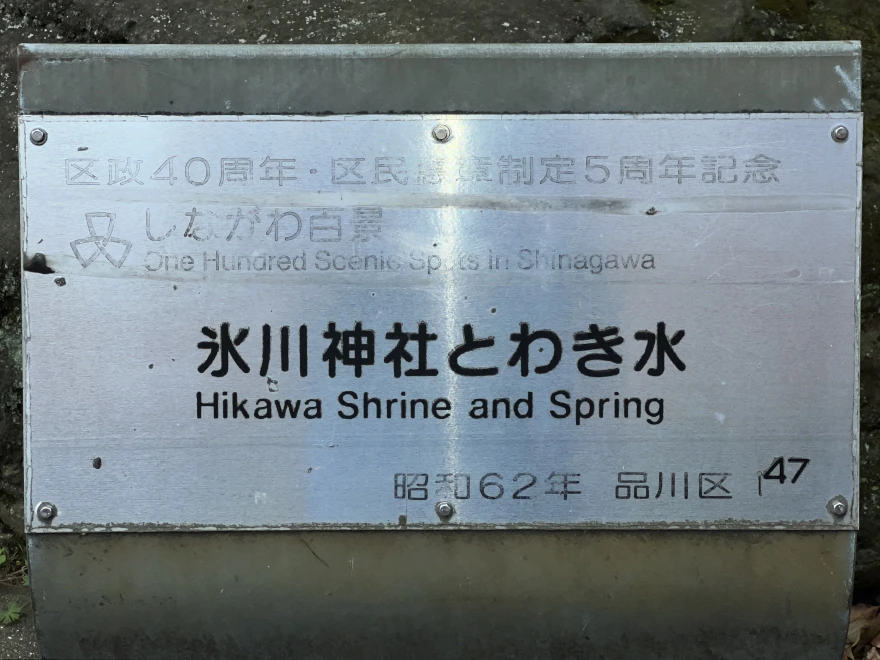
Getting a bit faded but still readable. It’s facing the road.
🖋️ Withervee Says…
Having found an Hikawa Shrine on top of TOC (without a sign) I was surprised to find this sign by the side of the road. But then how could a spring appear on the top of a building? So, if you visit TOC there is another one on the roof. (As of 2025, since TOC was brought back from the dead, you can no-longer go on the roof.)
On paper, Hikawa Shrine carries a lot of weight. It absorbed other shrines, sat at the centre of a village, and once drew people for its water rather than its prayers. None of that is immediately obvious when you arrive.
Today, the shrine feels restrained. The long approach quiets the street behind you. The spring is present, but modest. The former waterfall survives only as an idea you have to hold in your head. What remains is not spectacle, but continuity.
This is a place shaped more by administration than drama. Meiji consolidation, postwar rebuilding, neighbourhood maintenance. Its history accumulated through tidying-up rather than upheaval. That may explain why it now feels so settled.
Hikawa Shrine does not ask for attention. It waits. If you come expecting grandeur, you will miss it. If you come expecting layers to have flattened over time, this is exactly what that looks like.
🌳 Site Character
- Lifestyle 生活 (Seikatsu): ✔️
- Historical Significance 歴史 (Rekishi): ✔️
- Atmosphere/Natural Features 風土 (Fūdo): ✔️
👥 Who in their right mind would vote for this?
- Local shrine-goers
- Fans of quiet spots
- Urban explorers
- History lovers
- Spiritual walkers
📚 Further reading
Tokyo Jinjachō: Hikawa Shrine (Shinagawa) Official shrine registry entry listing enshrined deities, Meiji-era consolidation (1908), festival timing, and location.
Tesshō: Kirigaya Hikawa Shrine Summary drawing on Shinpen Musashi Fudoki-kō, including Genroku-period land-tax exemption and Edo-period administration by Anraku-ji.
Shinagawa Tourism Association: Hikawa Shrine Local reference noting the shrine’s spring, former waterfall, and role as a neighbourhood landmark.
🚶 While you’re there…
Nearby spots: A short walk for shopping at TOC and a walk up, or down Kamurozaka.
Previous
46: Kamurozaka Slope