
Once known for its abundant catch of fish and its role as a major producer of seaweed, Shinagawa-ura is today a quiet mooring place for fishing boats and brightly coloured yakatabune houseboats. The water remains central to the scene, even as the industry that once defined it has largely faded.
⚓ What are Shinagawa-ura Waters and Harbour?
Harbour, boats, and water.


See: harbour, boats, water, sky, and apartment blocks.
Shinagawa-ura formed part of Minami-Shinagawa-juku, the southern post station on the Tōkaidō. Originally, this was a fishing village projecting into Edo Bay at the point where the Meguro River once met the sea. The headland was used communally by fishermen, who spread their nets to dry and worked the shallow coastal waters. Even now, the layout of the area retains traces of the compact working settlement it once was.
📜 History of Shinagawa-ura
🌊 A shoreline shaped by river and tide
The area known historically as Susaki developed on a sandbank created by the gradual accumulation of silt at the mouth of the Meguro River. Early records describe it as an uninhabited stretch of land, sometimes referred to as Kabutojima, before it was drawn into the economic life of Shinagawa. Local tradition holds that a Benzaiten hall was established at the tip of the sandbank in the early Edo period, marking the site’s emergence as a place of worship as well as labour.
🚚 Relocation and the birth of a fishing town
In 1655, the first year of the Meireki era, residents of Minami-Shinagawa-juku who resisted the burdens of post-station horse duty were forcibly relocated here. Their move led to the formation of Minami-Shinagawa Ryōshi-machi, a fishing town that later became known as Shinagawa-ura. From this point, the settlement developed a clear maritime identity tied directly to Edo’s food supply.
🐟 Supplying Edo: the Osai Eight Ports
Shinagawa-ura became one of the shogunate’s officially recognised fish-supplying ports, part of a group known in Edo-period records as the Osai Hakkaura. These eight coastal fishing communities were granted special privileges to fish in Edo Bay in return for providing fresh fish to the shogun’s kitchen. Alongside Shinagawa-ura, the group included ports at Shiba, Honshiba, Ōi, Haneda, Namamugi, Shinjuku in present-day Yokohama, and Kanagawa. For many years, fish was delivered to Edo Castle several times each month.
🧾 Privilege, obligation, and gradual change
From 1792, this obligation was converted into a monetary payment, with a ceremonial monthly fish offering retained under the name ryōsho hatsuho. The same communities were also major centres of seaweed production, and Shinagawa-ura was particularly well known for its dried nori. This coastal economy continued into the modern period, before coming to an end with the construction of Tokyo Port in 1962. Fishing rights were transferred the following year, and seaweed cultivation around Shinagawa ceased soon after.
🟫 Reclamation and the working waterfront
During the late Edo period, land reclamation carried out by the Kagata family, leaders of Minami-Shinagawa-juku, reshaped the shoreline in front of the fishing town. This work gave rise to Minami-Shinagawa Shinkaiba, later known as Kagata Shinchi, further extending the working waterfront and reinforcing Shinagawa-ura’s role as a productive maritime edge rather than a scenic one.
⚓ From productive coast to quiet harbour
That productive role did not survive the twentieth century. With the construction of Tokyo Port in 1962, fishing rights in the area were transferred to the metropolitan authority, and seaweed cultivation around Shinagawa ended the following year. What remains today is not an industrial shoreline but a residual one: a small harbour used by fishing boats and yakatabune, where calm water and moored vessels quietly occupy a landscape once defined by work, obligation, and supply.
🖼️ Depictions of Shinagawa-ura during the Edo period

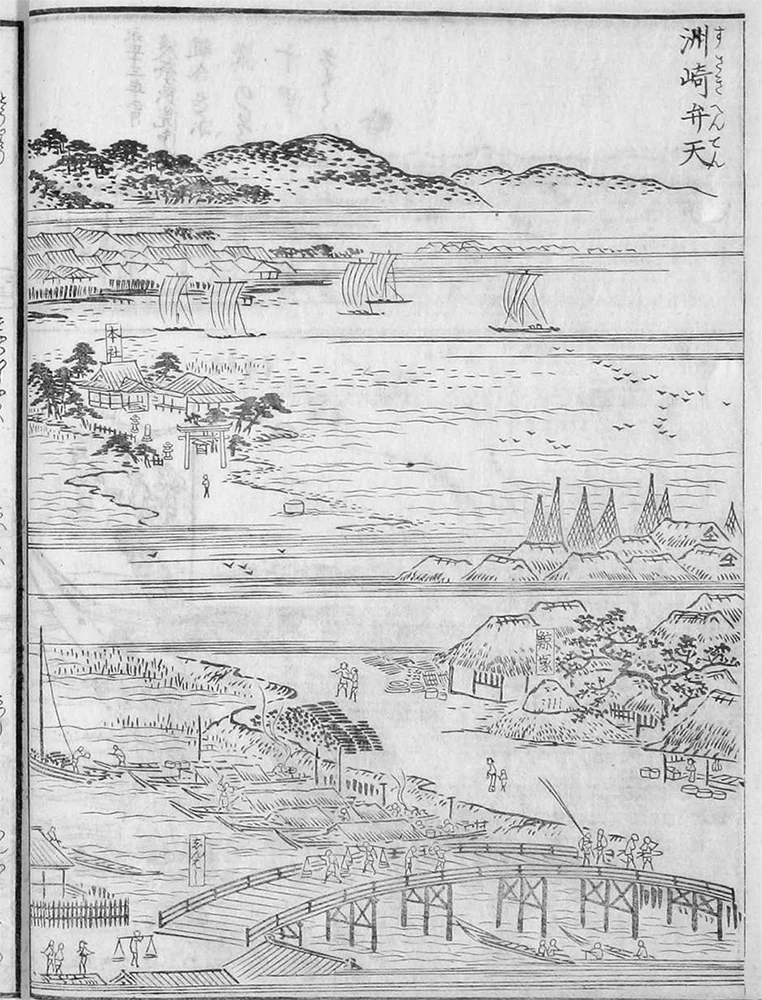
Shinagawa-ura also appears in illustrated guidebooks of the period, including Edo Meisho Zue, compiled and published in the Tenpō era (1834–1836). These images show a busy coastal settlement shaped by work, water, and movement, offering a glimpse of a shoreline that has since been almost entirely absorbed into the modern city.
🧭 Visitor Information
Location: Shinagawa-ura waterfront, Minami-Shinagawa, Shinagawa City, Tokyo
Best time to visit: Daytime, especially late morning or early afternoon for light and open views
Admission: Free
Facilities: No dedicated facilities. Benches and open space along the waterfront.
Notes: This is a working harbour and residential edge rather than a park. Please be mindful of boats, equipment, and local residents.
📍 Where is it?
| what3words | ///kipper.pine.soccer |
| latitude longitude | 35.6210272, 139.7392846 |
| Nearest station(s) | Kitashinagawa (Keikyu line) |
| Nearest public conveniences | South near the Whale Mound and Kagata Shrine |
🪧 Show me a sign

Nice sign. Right by the Kitashinagawa Bridge.
🖋️ Withervee Says…
Shinagawa-ura was not just a scenic bay. It was a food source for Edo Castle. Fish, clams, and seaweed from this stretch of water fed the city’s elite. The area formed part of the shogunate’s supplier network (osaiura). By the late seventeenth century, locals were also developing techniques for cultivating seaweed in shallow coastal waters, helping to establish Shinagawa as a major nori-producing area.
Today, the mood is very different. People linger here. They sit, rest, smoke, drink, and feed pigeons. On a warm day it becomes a comfortable lunchtime refuge for nearby workers. The Meguro River once flowed through this channel, but its course was later altered through flood control and river engineering. It now enters Tokyo Bay much further south, and its banks have since been reinforced.
If you walk further south, along the road on the right in the image below, past the whale monument, you reach a junction with Yamate-dōri. This road follows the former route of the Meguro River.

If you’ve grown tired of dense, built-up Tokyo, this is a good place to breathe. The open water creates wider skies than you might expect.
At the right time of year, you may spot large turtles in the canal if you look down from the bridge.
These days the harbour mainly serves as a mooring point for yakatabune and small marine tour boats. It does attract visitors, but it still feels more like a place to pause than a destination.
🌳 Site Character
- Lifestyle 生活 (Seikatsu): ✔️
- Historical Significance 歴史 (Rekishi): ✔️
- Atmosphere/Natural Features 風土 (Fūdo): ✔️
👥 Who in their right mind would vote for this?
- Fishing nostalgists
- Canal walkers
- Old Tokyo fans
- Boat photographers
- Seafood romantics
📚 Further reading
🚶 While you’re there…
Walk the boardwalk along the canal, visit the nearby Whale Mound and Kagata Shrine and Ebara Shrine, or enjoy a yakatabune dinner cruise if you time it right. Shinagawa’s old town is just around the bend.