
Togoshi Park – A Daimyō Garden Turned Public Retreat
🏯 From Daimyō Villa to Togoshi Park
The land now home to Togoshi Park (戸越公園 – Togoshi Koen) has a long history. In the early Edo period, the powerful Hosokawa clan – lords of Kumamoto in Kyushu – established a shimo-yashiki (lower villa) here in Shinagawa. Records from the late 17th century show the estate reached a scale of up to 330,000 m². The compound included formal halls, guest residences, and an elaborate kaiyū-shiki (strolling-style) garden.
The garden design reflected refined tastes of the time. The eastern section housed buildings and tea spaces, while the western garden featured a central pond shaped like Lake Biwa, artificial hills symbolizing Mt. Fuji and Mt. Tsukuba, and meandering paths meant for slow walking and seasonal enjoyment. It mirrored the style of the Hosokawa’s better-known Suizen-ji Garden in Kumamoto.
🏛️ Passage Through Aristocracy to Mitsui Ownership
After a fire in 1678 and changes in feudal administration, the Hosokawa gradually withdrew. In 1806, the land transferred to the Matsudaira clan of Uzen, then to the Matsue branch of the Matsudaira. In the Meiji period, it passed through several hands – including Count Hisamatsu and later the sculptor Hotta Zuishō – before the Mitsui family acquired it in 1890.
🧧 Mitsui & the Zaibatsu: Merchants, Bankers, Donors
The Mitsui family began in Edo as textile merchants and rose to become one of Japan’s major zaibatsu (財閥) – family-run industrial conglomerates that dominated banking, trade, and finance. Their Mitsui Bank was a forerunner of today’s SMBC Group. In 1932, they donated part of their Shinagawa estate, including the central garden, to Ebara Town. A donor plaque still stands near the entrance.
Note: Japan’s zaibatsu (財閥) – including Mitsui, Mitsubishi, and Sumitomo – were dismantled after World War II by Allied occupation authorities. The aim was to break up monopolies and democratize the economy. By 1947–48, holding companies were dissolved. However, many former zaibatsu firms regrouped as looser networks called keiretsu (系列) during Japan’s postwar recovery.
In 1935, the grounds opened to the public as Togoshi Park. Tokyo oversaw its early development, while Shinagawa Ward took full control in 1950. The park has since undergone several renovations aiming to preserve its original daimyō garden atmosphere.
🌳 Togoshi Park Today
Today, the park preserves much of its Edo-period layout. Visitors pass through traditional gates like the yakui-mon (main gate) and kabuki-mon (east gate), and follow stone paths through carefully arranged scenes. A pond reflects willows and azaleas. Koi swim under arched bridges. Seasonal flowers color the edges of footpaths. Though much smaller than its original scale, it remains a tranquil, tree-filled retreat.
🌱 Features, Flora, Fauna & Seasons
The design follows a traditional kaiyū-shiki (strolling-style) layout. Visitors pass through historic gates and find stepping stones, waterfalls, and landscaped views that shift as they move. While most of the park is shaded or wooded, there are small lawn spaces near benches and play areas.
Play and relax: Children enjoy two playground areas with swings, slides, and sand pits. Benches and open lawns support family picnics and morning gatherings like gateball and radio calisthenics.
Flora by season:
- Spring: Cherry blossoms, plum, magnolia, dogwood, azaleas
- Summer: Hydrangea, crape myrtle, irises, southern magnolia
- Autumn: Ginkgo and maple trees for vibrant koyo (autumn leaves)
- Winter: Camellia and sasanqua add color to bare paths
Wildlife: Turtles sun themselves on rocks. Koi swim beneath willow leaves. Migrating ducks and small birds bring the pond to life. Seasonal insects and spotted crayfish make it a lively microhabitat for nature lovers.
🧭 Togoshi Park Visitor Information
Address: 2-1-30 Toyocho, Shinagawa-ku, Tokyo 142-0042
Access: 6-minute walk from Togoshi Koen Station (Tokyu Oimachi Line), 8-minute walk from Shimo-shimmei Station (Tokyu Oimachi Line)
Open: Year-round, no closing days
Admission: Free
Official Info: Shinagawa City Togoshi Park
Where is it?
| what3words | ///clearing.hems.thing |
| latitude longitude | 35.610783, 139.722582 |
| Nearest station(s) | Togoshi Koen Station (Oimachi Line) Togoshi Station (Asakusa Line) Togoshi-Ginza Station (Ikegami Line) |
| Nearest public conveniences | Inside park near main entrance |
Show me a sign.
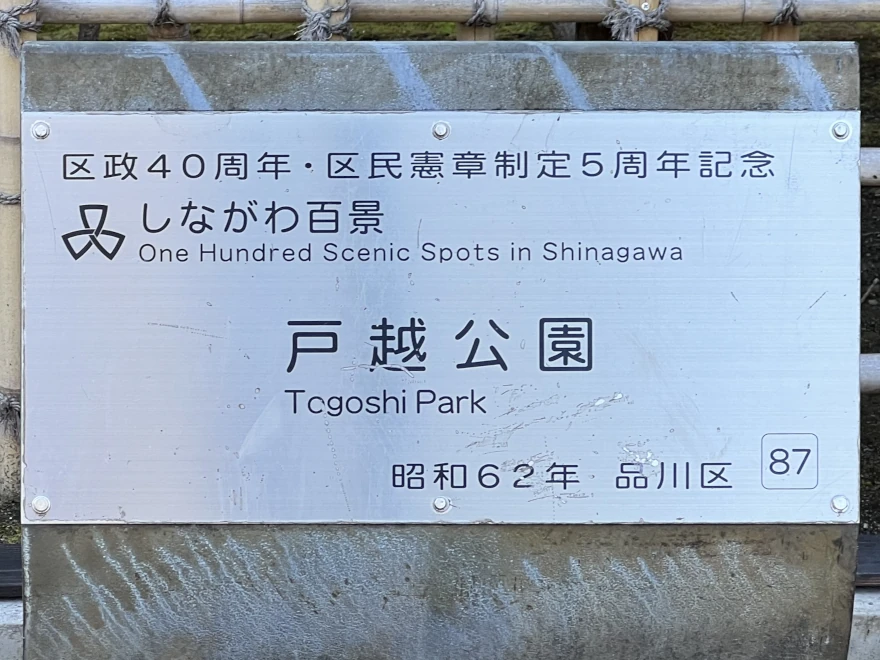
The Hyakkei sign stands just inside the main gate.
Withervee says…
There’s something very “Taishō Romantic” about this park – a little faded, but full of charm. Good benches, good reflections, good for the soul.
Site Character
- Lifestyle 生活 (Seikatsu): ✔️
- Historical Significance 歴史 (Rekishi): ✔️
- Atmosphere/Natural Features 風土 (Fūdo): ✔️
Who in their right mind would vote for this?
- Retired gardeners
- Meiji/Edo history buffs
- Photography clubs
- Local families with strollers
- Leaf-peepers and blossom-watchers
Further reading
While you’re there…
There’s more to explore just steps from the park. Visit the nearby Togoshi Hachiman-jinja Shrine (Spot 86). For families, Shinmei Children’s Playground (Spot 111) features a mollusc designed for kids to play on. For shopping and snacks – there is Togoshi Ginza. Finally, for some quiet reading or a shady stroll, stop by Bunko no Mori (Spot 109), the lush library park just around the corner.