
🌿 Nagisa no Mori – Coastal forest, tidal edge, and quiet birdwatching
Nagisa no Mori (なぎさの森) is the nature-focused side of Ōi Futo Chūō Kaihin Park (大井ふ頭中央海浜公園). It sits beside the Keihin Canal, opposite the busier Sports no Mori area, so you can swap stadium noise for reeds, water, and sky in minutes.
Although this is still “Tokyo waterfront”, it feels surprisingly low-key. Because the park mixes shoreline access with conservation zones, you will also see fences, signs, and clearly-marked no-entry sections. As a result, the best visits are slow ones. Walk, pause, and watch what comes to you.
🦆 What you can do here
Nagisa no Mori is set up for simple pleasures: a waterside walk, a bit of shoreline fishing where permitted, and birdwatching from purpose-built features such as an observation wall and a birdwatching hut. If you bring binoculars, you will get more from the place.
🏖 Shoreline zones you will see on the map
The official park map names several shoreline points, including Yūyake Nagisa (夕やけなぎさ) and rocky edges such as Haze-tsuki Iso (はぜつき磯), Shioji Iso (しおじ磯), and Midori-ga-hama (みどりヶ浜). These names are useful because the rules can change by section, so it helps to know where you are standing.
In particular, some stretches are conservation areas where entry and fishing are prohibited. The signage matters here, so check it before you step down to the water.
🎣 Fish and fishing
Haze-tsuki Iso (はぜつき磯) is widely recognised by local anglers as a place associated with Japanese goby (Haze・ハゼ). The name itself points to this connection, referring to a rocky shoreline where goby are commonly found. This stretch of the Keihin Canal has long been used for casual, family-friendly fishing rather than competitive or specialist angling.
Fishing here is typically simple and seasonal. During summer and early autumn, anglers often target goby using short rods or light “choi-nage” casting from the shoreline. Because the water becomes very shallow at low tide, fishing is usually better as the tide rises. The mixed terrain of sand and large stones creates small pockets where fish shelter from current and boat movement.
In addition to goby, visitors and anglers occasionally report seeing or catching species such as flathead grey mullet (Bora・ボラ) and small sea bass (Suzuki・スズキ), particularly closer to dusk. Fish jumping in the canal is a common sight, especially in warmer months, even for visitors who are not fishing.
Fishing is only permitted in designated zones, and restrictions vary by location and season. Signs on site are authoritative, and conservation areas are strictly off-limits. Anyone planning to fish should check the posted rules before setting up.
🍖 Haze-tsuki Iso BBQ area
If you want a more social visit, the Haze-tsuki Iso BBQ area operates as a bookable barbecue zone. You can bring your own equipment and food, and the site is free to use, however booking is required. Because closing time is firm, plan to start early and pack up properly.
🕊 Birdlife
The mix of canal water, tidal edge, reeds, and open sky makes Nagisa no Mori a reliable place for birdwatching. Even short visits often reveal movement and sound, especially early in the morning or toward evening.
Commonly observed birds include:
- great cormorant (Kawau・カワウ), which can be seen swimming in the canal, perched on structures, or flying low over the water.
- grey heron (Aosagi・アオサギ)
- little egret (Kosagi・コサギ) are also frequent visitors, standing motionless along the shoreline while watching for fish.
- black-headed gull (Yurikamome・ユリカモメ) appear in cooler seasons overhead and along the water.
- spot-billed duck (Karugamo・カルガモ) are often seen resting near calmer edges.
- Smaller birds such as brown-eared bulbul (Hiyodori・ヒヨドリ).
- white wagtail (Hakusekirei・ハクセキレイ) move between trees and paths.
- And, of course, the crow (Kuraso・クラソ) in case you have somehow missed them.
The park’s observation wall and birdwatching hut encourage quiet viewing rather than close approach. Because parts of the shoreline are protected, birds are less disturbed here than in fully open waterfront parks, which makes patient watching particularly rewarding.
🧭 Visitor Information
Address: 4-2-1 Yashio, Shinagawa-ku, Tokyo (東京都品川区八潮4丁目2番1号)
Opened: 1 April 1978 (Ōi Futo Chūō Kaihin Park: Sports no Mori + Nagisa no Mori)
Key facilities (Nagisa no Mori side): Nagisa no Mori management hut (information), birdwatching hut and observation wall, shoreline zones (including Yūyake Nagisa), conservation areas, and the Haze-tsuki Iso BBQ area
Management hut hours: 09:00–16:30 (may close temporarily due to circumstances)
Observation wall hours: Saturdays, Sundays, and public holidays 09:30–16:00
Closed: 29 December–3 January (management hut)
BBQ days and times: Mon, Thu, Fri, Sat, Sun (closed Tue/Wed). 11:00–17:00 (packing from 16:30 as the gate closes at 17:00). Booking required.
BBQ booking: If renting BBQ grills etc., book via the reservation site. If bringing all equipment, book by email or phone (details on the official page).
Parking: “Nagisa no Mori Times” car park (40 spaces). 300 yen for 1 hour, then 100 yen per 30 minutes. Open 24 hours.
Admission: Free
Official info: Ōi Futo Chūō Kaihin Park: Nagisa no Mori (official page)
BBQ details: Haze-tsuki Iso BBQ area (days, hours, and booking)
Where is it?
| what3words | ///infuses.lays.engage |
| latitude longitude | 35.594433, 139.751389 |
| Nearest station(s) | Ōi Keibajō-mae Station (Tokyo Monorail) also: (Toei Bus routes 品91 / 井92 (“Yashio Minami”) Keikyu Bus 森22 (“Chūō Kōen”) |
| Nearest public conveniences | On-site facilities inc. near stadium entrance |
Show me a sign.
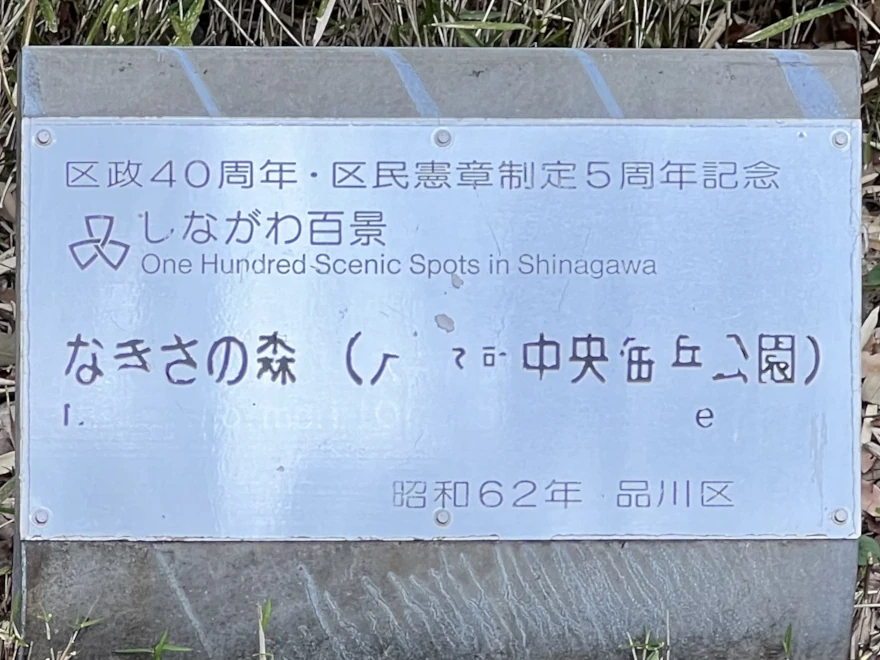
To be found near the east entrance opposite the Sports Forest.
Withervee says…
Nagisa no Mori sits in an uneasy but interesting middle ground. On one hand, it invites people in with fishing spots, barbecue areas, and long, quiet paths by the water. On the other, it draws firm lines around what must be protected. Fences, signs, and closed-off shoreline sections are not decoration here – they are reminders that this place is managed as habitat first and leisure second.
It also helps to remember that this is not an ancient forest. The land itself is reclaimed, and the woodland was planted deliberately in the mid 1970s. Over time, however, the trees have thickened and you can forget for a while that you’re in Tokyo. Stand on the nature observation path and it is easy to forget how close the road really is.
Nagisa no Mori is not dramatic, and it does not entertain you. Instead, it asks you to slow down, respect the rules, and accept that sharing the waterfront means sharing it with fish, birds, and limits. If you can live with that, it becomes one of Shinagawa’s most quietly absorbing places.
Visitors to Nagisa no Mori
Visitors tend to agree on the atmosphere. Early mornings are calm, even on weekends. Runners appreciate the space before the crowds arrive. Birdwatchers linger by the observation hut. Others notice the rough edges: loud crows, feral cats along the canal, dim lighting at night, and a scattering of mysterious sculptures that seem to have grown out of maintenance materials.
Note for birdwatchers – not far away there is Tokyo Port Wild Bird Park (東京港野鳥公園). It’s not free – currently ¥300.
Site Character
- Lifestyle 生活 (Seikatsu): ✔️
- Historical Significance 歴史 (Rekishi): ❌
- Atmosphere/Natural Features 風土 (Fūdo): ✔️
Who in their right mind would vote for this?
- Birdwatchers
- Anglers
- Quiet walkers and sketchers
- Photographers
- Tree huggers
📚 Further reading
Tokyo Metropolitan Park Association: Ōi Futo Chūō Kaihin Park (Sports no Mori & Nagisa no Mori)
Official site: Nagisa no Mori (なぎさの森)
Official notice: Haze-tsuki Iso BBQ Area (booking method, days closed, hours, seasonal plans)
While you’re there…
Combine this with a visit to the Sports Forest for a perfect mix of action and tranquility.
And, if you’re not seeing enough birdlife wander over to Tokyo Port Wild Bird Park 東京港野鳥公園